Etsy rewrote its artificial intelligence rules in October. Patterns for knitting, sewing and embroidery, along with recipes, woodworking plans and assembly guides, can no longer be produced by a model. Sellers have to write the instructions themselves and show a real example of the finished item before the listing goes live.
Framed as moderation, that reads like housekeeping. Framed as culture, it's something much older. A marketplace just declared that certain skills cannot be transmitted by software that has never held the tool, and it wrote that declaration into a policy page. Craft guilds spent about six centuries making the same claim with a charter, a hall, and a panel of masters deciding whether a candidate's masterpiece was good enough to sell.
The economics on the other side of that line are small, specific and unforgiving. The 2026 Craft Apprentice Program, run by the Maine Crafts Association with the Maine Arts Commission and the League of New Hampshire Craftsmen, selected seven mentor and apprentice pairs this year. Each pair gets 100 hours of one to one training across seven months. The mentor receives $5,000, the apprentice $3,000.
What the Marketplace Rule Actually Enforces
The category Etsy singled out matters. A faked photograph of a sweater is a nuisance. A faked pattern is a different kind of harm, because it costs the buyer something unrecoverable: the hours at the needles and the money spent on yarn before the garment fails.
Functional knowledge has this awkward property. It can't be verified from an image, and it can't be inferred from a description that reads well. The historical guild answered with a demonstration, assessed by people who could tell competent work from confident work. The platform has landed on a weaker version of the same test, a photograph of the object the instructions supposedly produce. It's a low bar, and it still filters out a lot of what has flooded fiber marketplaces in the past two years.
Knitwear designers have described watching their sales halve as AI generated patterns multiplied underneath their own product photos. The grievance isn't piracy in the strict copyright sense. It's that buyers can no longer tell whether a seller has ever finished the thing they're selling.
The Money Behind a Hundred Hours
Set the models beside each other and the shape of the problem becomes visible.
| Model | Cost to train one maker | Time commitment | Who pays |
|---|---|---|---|
| Guild style apprenticeship, Maine and New Hampshire | $8,000 in combined honoraria | 100 hours across seven months | State arts funding and partner organisations |
| Heritage Crafts endangered crafts grant, UK | Up to £2,500 | Project based | Charity fund |
| Commercial pattern listing | Often under $15 | None | The buyer |
| Japanese workshop training | Minimal stipend in most workshops | Often several years | The apprentice absorbs it |
Divide the New England figure and you get $80 per hour of one to one instruction. That is close to the honest cost of transferring a skill that lives in hands rather than in text, and it explains why the model almost never survives without subsidy.
Heritage Crafts caps its Endangered Crafts Fund at £2,500 and aims the money at root problems such as too few trainees or outdated tooling. Spread across a 100 hour apprenticeship, that ceiling would pay about £25 an hour, roughly a third of the New England rate. The grant is designed to cover equipment and business coaching as well as teaching time, yet the limit still tells you what the funding landscape assumes a craft hour is worth. The apprentice honorarium is the line worth sitting with. Three thousand dollars across 100 hours is $30 an hour paid to the learner, which treats training as labor rather than charity. An apprentice who isn't paid can't stay, and the program's designers clearly knew it.
Why the Slow Model Cannot Scale
Mentor hours are the hard constraint. A master's teaching hour is an hour not spent at the bench, and no grant removes that trade-off. A teaching workshop is also a different room from a producing workshop, which is why so much advice about building a workspace that supports sustained concentration fits awkwardly onto a bench that has to absorb a beginner's mistakes.
The New Orleans Master Crafts Guild runs an apprenticeship track in ironwork, woodworking and plastering that ends in a journeyman review before a panel of masters. That review is a quality gate, and quality gates don't scale. Alongside it sits a business development program covering pricing, contracts, insurance and licensing. That second track is the revealing one. The modern guild has to teach commerce as well as craft, because a skilled maker who can't price work becomes a former maker within a season.
Guilds once restricted entry to protect standards and hold prices. The modern version restricts entry for a blunter reason: there aren't enough masters to go around. Same bottleneck, entirely different motive, and far less leverage over the market.
The Inventory of What Didn't Transfer
Heritage Crafts published the fifth edition of its Red List of Endangered Crafts in May 2025. It assessed 285 crafts, added 20 new entries, and now counts 165 at risk, split between 93 endangered and 72 critically endangered, with five already extinct. Cut crystal glass making, quilting in a frame and rattan furniture making all moved into the critical category. Rising operating costs, thin structured training and market pressure did the damage.
Daniel Carpenter, executive director of Heritage Crafts, wrote at the launch: "The Red List underscores the urgent need for greater investment and support to safeguard these skills for the next generation." Read past the alarm and the document is essentially a register of teachers who never found a successor.
Japan shows where that curve ends. Production value in the traditional crafts sector has fallen from a 1983 peak of 540 billion yen to roughly 105 billion yen in fiscal 2022, according to the Association for the Promotion of Traditional Craft Industries. Set that against the record 42.68 million inbound visitors in 2025 and domestic traditional craft output works out to about 2,460 yen per visitor for the entire year. Enormous tourist demand, and almost none of it converts into a single trained hand.
What Replication Cannot Hold
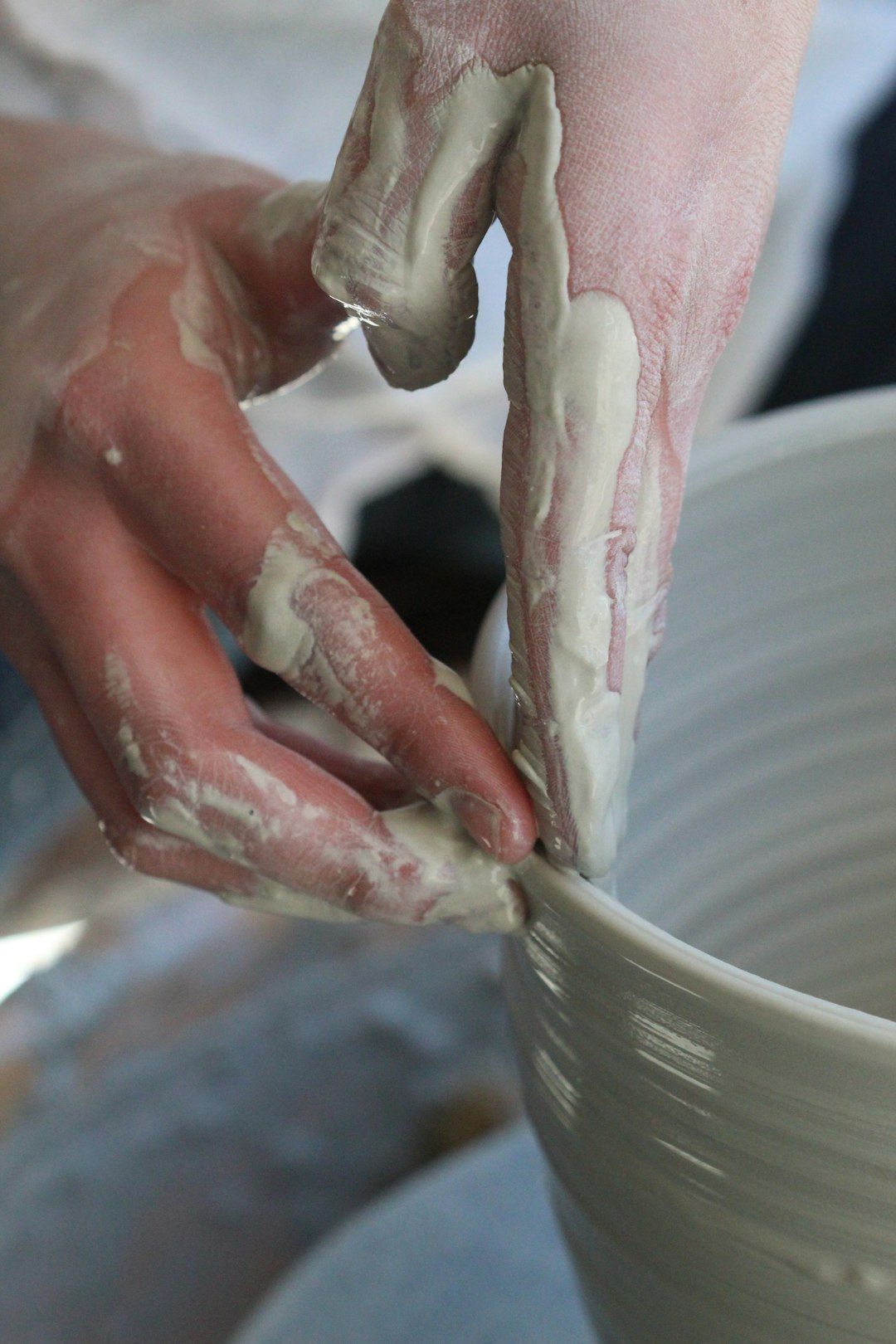
Factories can reproduce a shape with unnerving precision now, and a generated pattern can approximate the instructions that produce one. What neither can hold is diagnosis. The potter reading a kiln by sound and color, the weaver feeling tension through a warp, the joiner stopping a cut because something in the grain is wrong: that is knowledge built from accumulated error, and it only transfers from a person who has already made the mistakes.
This is why an apprenticeship is expensive by design. You aren't buying instruction. You're buying supervised failure, which is slow, unglamorous, and impossible to compress into a PDF that someone else's model assembled in an afternoon.
The guild never disappeared. It relocated into a listing policy, a grant application form, and a seven month contract between two people in a cold studio. What it shed along the way was the hall, the charter, and the local monopoly that once made slow training pay for itself. Those hours now have to be bought by a state arts council, a small charity, or a customer who thinks to ask who actually made the thing.
Strategic Takeaways
- ✓Etsy's October policy on AI generated patterns works as a private guild standard, requiring sellers to prove a human actually made the object they are teaching.
- ✓A structured apprenticeship in New England now costs roughly $80 per hour of one to one instruction, which is why nearly every serious program leans on public money or a charity grant.
- ✓Replication copies the shape of an object and skips the diagnostic judgment behind it, and that judgment is what the endangered craft lists are really counting.

Anthony Dami
Technology & Culture writer at Largern, focusing on AI, consumer hardware, film, internet culture, and the routines and tools behind everyday life.
Comments (0)
No comments yet
Be the first reader to share your perspective on this story.