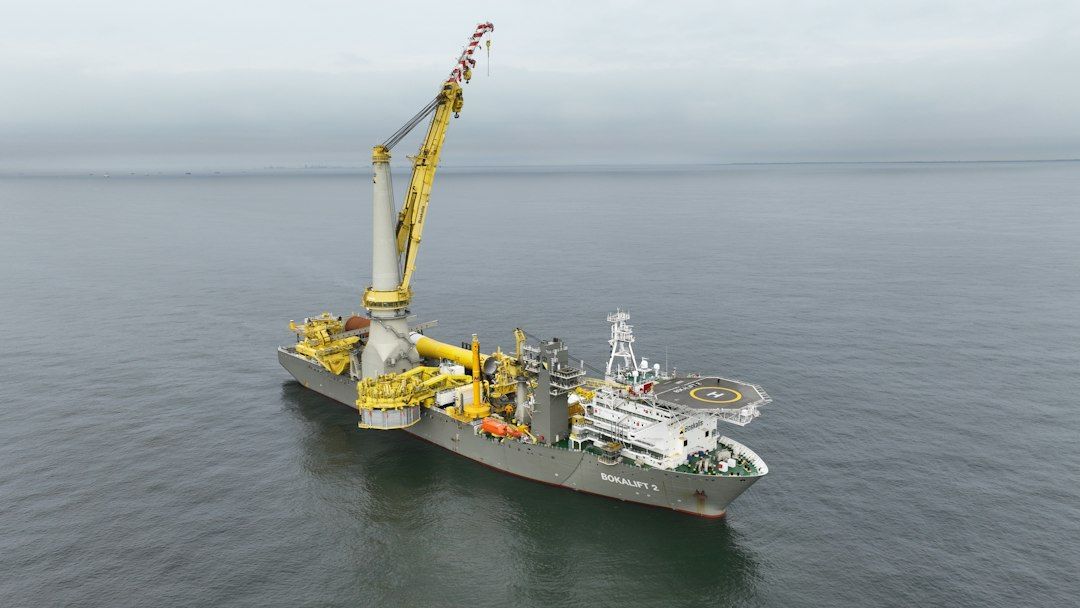
The MV Maasvliet left drydock in January 2025 and was already on its fourth voyage by autumn, which says something about how quickly the deep-sea repair trade puts new tonnage to work. What that voyage involved is harder to picture. Off the Portuguese coast, the crew spent weeks grappling a cable called TAT-8 off the seabed, the first fiber-optic system ever laid across an ocean, running nearly 6,000 kilometers from Tuckerton, New Jersey to a branching unit that split traffic toward Widemouth Bay in England and Penmarch in France. It entered service on 14 December 1988, exhausted its design capacity within 18 months, and was abandoned in 2002 after a fault that would have cost more to fix than the remaining capacity was worth.
Recovering it meant coiling the cable by hand on deck. A winch that hauls evenly will still bend glass past its minimum radius, and fiber bent past that limit does not spring back. The recovery crew's most delicate instrument turned out to be patience.
The Fleet Is Smaller Than the Map Suggests
Convert the industry's totals into rates and the constraint appears immediately. Submarine cables carry more than 99 percent of intercontinental data, and the planted network has grown from roughly 1.5 million kilometers in 2013 to about 2.7 million today. Fault counts have stayed stubbornly flat through that expansion, at close to 199 a year on average across 2010 to 2024, which works out to nearly four breaks somewhere in the world every week. Fishing gear and anchors cause about 86 percent of them, which is why failures cluster over the crowded continental shelf rather than in the empty middle of the ocean.
The vessels that answer those calls are a far smaller pool than the stakes imply. Public tallies put the global fleet of cable-capable ships at roughly 60 hulls, and fewer than 20 of those work full time on repair rather than installation, survey, or decommissioning. Divide 2.7 million kilometers by that dedicated repair fleet and each ship is nominally responsible for something like 135,000 kilometers of seabed, more than three times the circumference of the Earth.
The International Cable Protection Committee's 2026 plenary, held in Athens, recorded 178 repairs completed in 2025, below the recent annual average of about 190. On paper that reads as a quieter year. It is not evidence of slack, because the same meeting flagged the arrival of deepwater congestion in the Atlantic, where new high-capacity routes now share a narrowing corridor of seabed with pipelines, trawler grounds, and older systems approaching end of life.
Where the Month Actually Goes
A repair looks like a sailing problem and behaves like a filing problem. The technical sequence is well understood. Terminal equipment at both landings fires test pulses down the fiber and measures the reflection, localizing a break to within a few hundred meters. A maintenance authority for that ocean region then tasks the nearest suitable vessel. Then that vessel has to obtain permission to work, which means customs clearance, a coastal state permit covering the exclusive economic zone, sometimes a marine license and an environmental review, and a port willing to take on cable spools and fuel.
The 2025 figures make the split visible. Vessels averaged 23.4 days between notification and departure, then 7.7 days in transit to the fault site. Set those side by side and about 75 percent of the response clock is consumed by tasking and paperwork rather than by the ocean. The repair system behaves like an ambulance crew that cannot switch on the siren until every municipality it drives through signs a permission slip.
| Metric | 2025 figure | Consequence |
|---|---|---|
| Cable route length | ~2.7 million km | up from 1.5 million in 2013 |
| Faults per year | ~199 average, 2010 to 2024 | nearly four a week worldwide |
| Repairs completed | 178 | below the recent run rate |
| Cable-capable ships | ~60 worldwide | shared with installation work |
| Dedicated repair ships | fewer than 20 | ~135,000 km each on paper |
| Notification to departure | 23.4 days average | permits, customs, tasking |
| Transit to fault site | 7.7 days average | weather and distance |
| Fleet reaching end of service life by 2040 | two-thirds | replacement, not expansion |
Averages hide a long tail. One repair in the 2025 dataset took 947 days from notification to recovery, which is not a function of distance or depth but of permissions that arrived late or never arrived. Weather adds its own variance, since a grapnel operation in a winter North Atlantic swell can lose days at a time to sea state, and no amount of ship capacity fixes that.
A Splice at Four Kilometers Is Not a Patch
Cable is not one product. It is a stack chosen by depth and threat model, and the choice determines what a crew can physically do with it: light wire armored cable for the continental rise where occasional trawling matters, single armored cable for the shelf, double armored cable for the last few kilometers into shore, where anchors, nets, and dredging do most of the world's damage, and lightweight cable for the abyssal plain, built around the fiber unit with minimal steel because nothing down there drags an anchor.
The recovery mechanics are cruder than people expect. The ship drags a grapnel across the seabed until it hooks the cable, cuts one side, and brings that end to the surface while a buoy marks the other. The damaged length is replaced rather than repaired in place. A new section is jointed on deck inside a mold, the joint is injected and cured under pressure to restore the mechanical strength of the armor wires, and the assembly is paid back over the side with enough slack that the seabed contour does not load the joint in tension.
Glass constrains every one of those steps. Optical fiber has a minimum bend radius, and past it the light starts leaking out of the core with no recovery. It behaves like a kinked garden hose, except the kink does not come out when you release it, and the loss shows up as attenuation on a link that spans an ocean. Repeaters spaced tens of kilometers apart along the older systems add a second constraint, because a replacement section has to land between two powered housings rather than wherever the crew prefers.
The Fleet Ages Faster Than the Cables Do
Cable systems are designed on a 25 year horizon. Ships are not. Analysis published in 2025 put the bill at roughly $3 billion for 15 replacement vessels and five additional ones, which works out to about $150 million per hull before counting the remotely operated vehicle spread, the cable handling machinery, and the shore depot. With about two-thirds of the maintenance fleet reaching the end of its service life by 2040, the replacement order is not speculative. It is a scheduled invoice.
Ownership is where that invoice stalls. Repair is funded through maintenance agreements, in which cable owners in a given ocean region pay annual fees into a club that keeps a ship on station. The model recovers operating cost well, since the fee per system is small and predictable. It recovers capital badly, because a new vessel costs nine figures and outlives the commercial arrangements that justified it, and no single operator wants to finance a shared asset whose benefit lands on competitors.
The companies ordering the most new transatlantic capacity are also the least likely to buy a hull. Hyperscalers now finance dedicated power generation for AI campuses and sign 20-year offtake contracts to secure electrons, yet they treat the seabed fleet as somebody else's line item. The resilience they depend on is folded into the price of capacity, the same way idle servers and egress charges disappear into a cloud bill that no one itemizes.
The Bottleneck Sits in Port, Not at Sea
Governance has not scaled with the fleet either. The ICPC now counts 258 members across full, associate, and government categories, and the ITU's 2026 advisory body on submarine cable resilience has published working group findings on exactly this gap. The problem is not awareness. It is that no standard instrument exists for a coastal state to pre-authorize emergency cable repair in its waters, so every incident restarts from zero with whichever ministry happens to own the file that month.
Regional exposure sharpens the argument. Networks in parts of West and Central Africa and on isolated Pacific islands carry little route diversity, and a single fault there can take a country offline for weeks while a ship works through permissions from three jurisdictions. A standing repair protocol, published in advance and honored across neighboring states, is administratively dull and worth more than an extra hull in the water.
So the useful test for any fleet renewal plan is not how many ships it buys but whether it arrives alongside a permitting instrument that lets those ships move on the day they are tasked. Twenty new vessels entering a system that still requires 23 days of paperwork would shorten the 7.7 day sailing leg and leave the larger 23.4 day block untouched, which is an expensive way to improve roughly a quarter of the problem. The engineering at the bottom of the Atlantic has been settled since a crew proved it could cure a glass splice in a mold on a rolling deck. What remains unsettled is whether more than 150 coastal states can agree in advance to let a repair ship work, and until that has an answer, the slowest part of every repair will keep happening on land.
Strategic Takeaways
- ✓Fewer than 20 ships worldwide work full time repairing submarine cables, and they absorb roughly 178 repairs a year across a network of about 2.7 million kilometers.
- ✓In 2025 the average repair waited 23.4 days before a vessel left port and then spent 7.7 days sailing, so permitting and positioning consume about three quarters of the response clock.
- ✓Around $3 billion would replace and expand the fleet, but new hulls without standing cross-border permits will only produce faster ships waiting at anchor.

Anthony Dami
Technology & Culture writer at Largern, focusing on AI, consumer hardware, film, internet culture, and the routines and tools behind everyday life.
Comments (0)
No comments yet
Be the first reader to share your perspective on this story.