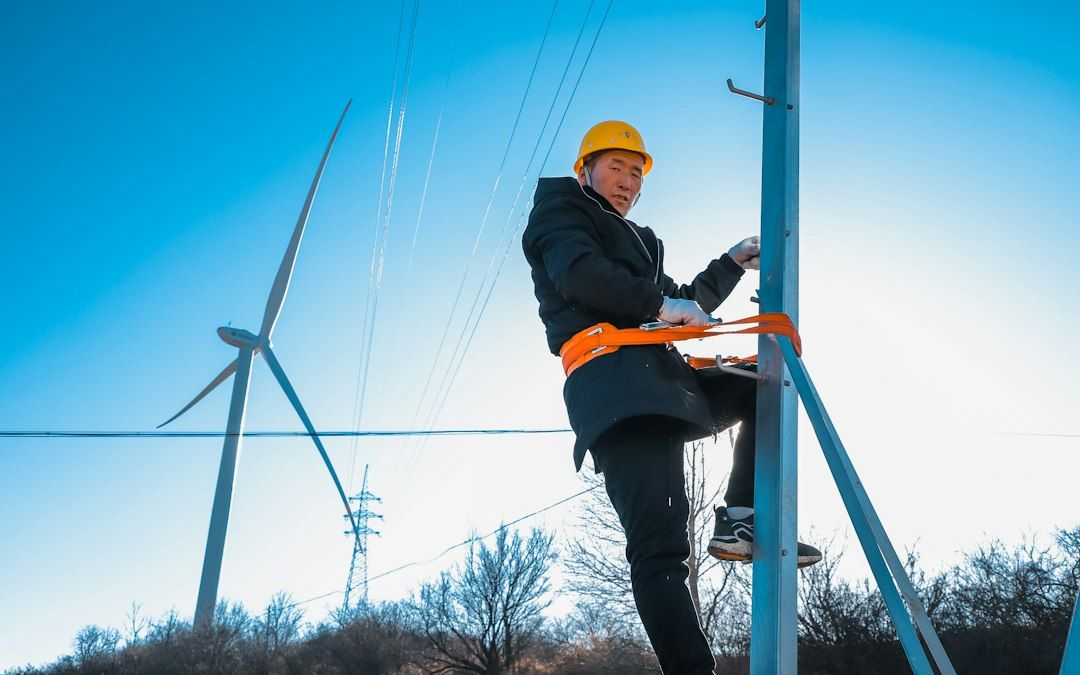
The first lesson taught inside a wind training center is that the climb is a procedure, not a feat. Trainees in the working-at-heights module learn to hook a fall-arrest trolley onto a steel rail before their boots leave the ground, to hold three points of contact on a ladder that runs the height of the tower, and to lower an unconscious colleague using a rescue kit they packed themselves. The training towers are short. The ladders inside them stand in for machines whose nacelles now sit well above 300 feet on the largest offshore platforms, and federal labor data puts the typical turbine ladder at 200 feet or more. That is a 20-story building climbed in boots, gloves and a harness, with a torque wrench waiting at the top.
The buildings that teach this sit at an awkward intersection of capital and timing. Wind Academy by Siemens Gamesa, the only manufacturer-run wind school in the United States, occupies a 40,000-square-foot facility near Orlando with nine classrooms, two simulation labs, three climbing towers and two full-size nacelles. It compresses GWO certification into roughly three weeks and advertises a 95% job acceptance rate for its graduates. The facility was financed against a forecast of American offshore construction that has since slipped, which is the tension every program in this sector is now managing.
What the Three-Hundred-Foot Climb Actually Tests
The entry credential is four days of instruction across four modules: working at heights, first aid, manual handling and fire awareness, with sea survival added for offshore work. None of it is glamorous. Most failure points are physical and administrative at once, a harness that doesn't fit, a rescue descent run too fast, a first-aid sequence lost under stress. The Global Wind Organisation revised eight of its training standards effective 10 March 2026, folding refresher requirements into the base standards so that recertification becomes a standing obligation instead of a one-time event.
The technical half of the job is where the labor market clears. A technician pulls fault logs from maintenance software, torques bolts to specification, traces a fault through a converter cabinet, and increasingly reads drone imagery of blade surfaces instead of dangling beside them. Universal Technical Institute structures its wind program around labs, climbing instruction and exposure to the software platforms operators actually run. The skill set is narrow by design. A licensed electrician who freezes at 200 feet is unhirable, and a confident climber who can't diagnose a yaw fault is just as stuck.
Narrowness is also why employers moved training off the farm and into accredited centers. Instruction at height carries insurance and liability consequences that a residential course does not, and the card issued at the end is logged in a registry any hiring manager can check. What results is unusual for a trade: a credential that carries the same weight in Hull, Melbourne and Orlando.
The Credential Stack Costs Less Than the Industry Assumes
Price is the first thing prospective technicians ask about and the last thing the industry advertises clearly. Accredited four-day safety courses are commodity products with published rates, and the spread between the cheapest and most expensive routes is wide enough to matter on an entry-level wage.
| Line item | What it covers | Published cost |
|---|---|---|
| GWO Basic Safety Training, community college (US) | Four modules plus practical assessment | $1,290 per person |
| GWO Basic Safety Training, specialist provider (US) | Same modules plus equipment certification | $2,000 per student |
| GWO Basic Safety Training, UK | Four-day course, VAT included | £1,110 |
| GWO Basic Safety Training, Australia | Four days, face to face | A$2,205 |
| Median wind technician wage, US (May 2025) | Bureau of Labor Statistics figure | $64,120 a year, $30.83 an hour |
| Tenth percentile wage, US | New entrants | $49,230 a year, $23.67 an hour |
| Ninetieth percentile wage, US | Complex fault diagnosis | $92,460 a year, $44.45 an hour |
Read against pay, the numbers get more interesting. The median wind technician earned $64,120 in May 2025, according to the Bureau of Labor Statistics, which works out to $30.83 an hour. A $2,000 safety course therefore costs about 65 hours of median pre-tax pay. At the tenth percentile, where new entrants start at $23.67 an hour, the same course costs 84.5 hours, roughly 30% more of a paycheck for a worker who has less of one. Choosing the $1,290 community college route brings the entry-level cost down to about 55 hours.
That comparison matters because the certificate is not a one-time purchase. Refreshers recur across a career, and the 2026 standard update made that rhythm explicit. A technician who budgets only for the initial course is budgeting for the first two years of a 30-year trade. The good news is that the total stays small against the wage it unlocks, which is rare among credentials sold to people without degrees.
Why the Boom That Built These Programs Stalled
Most American training capacity in this field was commissioned between 2022 and 2024, when federal leasing targets and state procurement mandates implied a decade of steady offshore construction along the East Coast. That construction has not materialized on schedule. Projects have been cancelled, paused or renegotiated through a stretch of legal and administrative pressure, and the workforce programs built to staff them have spent this year rewriting curricula around transferable energy and infrastructure skills.
The symptoms are visible on enrollment pages. A five-week utility-partnered technician program at a Long Island college has stopped accepting students. A CUNY community college is still recruiting for a 2026 offshore service technician cohort, training people for an industry whose near-term project list is thinner than it was when the grant was written. Neither outcome is a failure of instruction. Both are what happens when training capacity is built two to four years ahead of the construction it serves.
Salary data reflects the confusion. Public aggregators put the average offshore wind technician anywhere between roughly $54,000 and $83,000, a spread wide enough that it describes sample sizes rather than pay scales. The BLS occupation figure is the more defensible anchor, and it shows the real money sits at the top of the skill ladder: the ninetieth percentile earns $92,460, about 44% above the median. That gap has little to do with the sea. It reflects what employers pay for people who can diagnose complex faults without calling the manufacturer.
What European and Australian Programs Do Differently
In the UK, the training route runs through employers rather than individuals. Siemens Gamesa partners with colleges including Hull College on wind turbine apprenticeships that begin in September 2026, with learning split between a manufacturer training center and site work. A four-day GWO basic safety course at a British maritime academy is listed at £1,110 including VAT, which a sponsoring employer typically absorbs. The apprentice's out-of-pocket cost approaches zero, and the employer gets a technician trained on its own hardware.
Australia prices the same certificate at A$2,205 for four days, delivered face to face in Melbourne, Perth, Brisbane, Ballarat, Adelaide, Sydney and Dubbo, with on-site delivery at wind farms available as an option. Dutch providers run offshore versions for crews rotating between North Sea assets, often in multiple languages. Course content is nearly identical across all three markets because the GWO standard is the same document. The difference is who signs the invoice.
That difference shapes who enters the trade. Where employers and governments underwrite training, the pipeline fills with career changers and school leavers who couldn't otherwise afford a course plus four days of unpaid time. Where individuals carry the cost, the pipeline narrows toward people with savings, supportive parents or a military benefits package. The American model produces technicians, but it screens for the ability to write a check first.
What to Do If You're Weighing This Route
For anyone considering the climb, the advice is unromantic. Treat the certificate as the asset and the employer as its temporary custodian.
- Confirm the provider is GWO-accredited and that certification is logged in the registry, not just handed over as a paper card.
- Price the community college route before the specialist one. The modules are the same and the spread runs about 55%.
- Budget for refreshers from year two onward, not just for the initial course.
- Take the advanced rescue module early, since it is what makes a technician deployable on offshore assets.
- Build the diagnostic and software side deliberately, because that is where the gap between median and ninetieth percentile lives.
Offshore rotations also compress work into two-week blocks away from home, and the discipline of recovering between them is its own skill, one that rarely appears in a course syllabus. The technicians climbing 300 feet today hold a credential likely to outlive several of the companies that hired them. That is the honest case for the training centers, and the uncomfortable one too: the card is portable precisely because the industry paying for it is not guaranteed to stay in one country or one political cycle. Anyone signing up should be buying the card, not the promise stapled to it.
Strategic Takeaways
- ✓The Global Wind Organisation safety certificate is the durable asset in this career, because it transfers between employers, countries and adjacent energy work.
- ✓A basic safety course costs between $1,290 and $2,000 in the United States, roughly 65 hours of median technician pay and about 85 hours at entry-level wages.
- ✓American offshore construction has stalled, so training centers now sell portability rather than a guaranteed pipeline into one industry.

Largern Staff
Collaborative ideas and essays from the Largern desk on the ideas, habits, and shifts shaping modern life.
Comments (0)
No comments yet
Be the first reader to share your perspective on this story.